
Bizzdesign Unify: An AI-native platform for faster, better transformation decisions.
Bizzdesign appoints Daniel Hebda as Head of AI
Bizzdesign appoints Daniel Hebda as Head of AI
May 6, 2026
New role reinforces Bizzdesign’s commitment to scaling AI-native enterprise transformation.
ENSCHEDE, Netherlands — Bizzdesign, a global enterprise transformation SaaS company, today announced the appointment of Daniel Hebda as Head of AI. In this newly created role, Hebda will lead Bizzdesign’s global AI agenda, covering market evangelism, customer engagement, best practice advisory, and AI adoption in Bizzdesign’s business operations.
About Bizzdesign
Bizzdesign is a global enterprise transformation SaaS company, offering an end-to-end suite spanning Enterprise Architecture, Strategic Portfolio Management, Governance, Risk & Compliance, and Transformation Collaboration. Through a data-driven and AI-powered approach, Bizzdesign accelerates transformation from vision to value by enabling teams to plan, design and govern change collaboratively.
FAQs
Enterprise transformation in the AI era requires more than disconnected experiments or isolated tools. Organizations need to connect AI initiatives to strategy, architecture, portfolio decisions, governance, and execution. Bizzdesign is addressing that challenge by bringing AI into transformation planning, design, and governance, including through Bizzdesign Unify, its new AI-native platform for transformation collaboration.
Bizzdesign Named a Leader in Strategic Portfolio Management Tools, Q2 2026 Report by Independent Research Firm
Bizzdesign Named a Leader in Strategic Portfolio Management Tools, Q2 2026 Report by Independent Research Firm
April 29, 2026
Enschede, Netherlands — Bizzdesign, a global enterprise transformation SaaS company, has been named a Leader in The Forrester Wave™: Strategic Portfolio Management Tools, Q2 2026, which evaluated 13 of the most significant providers in the market.
About Bizzdesign
Bizzdesign is a global enterprise transformation SaaS company, offering an end-to-end suite spanning Enterprise Architecture, Strategic Portfolio Management, Governance, Risk & Compliance, and Transformation Collaboration. Through a data-driven and AI-powered approach, Bizzdesign accelerates transformation from vision to value by enabling teams to plan, design and govern change collaboratively.
FAQs
Strategic Portfolio Management is the discipline of aligning enterprise strategy with investments, capabilities, resources, and execution.
Organizations choose Bizzdesign when they need stronger alignment between strategic planning, portfolio decisions, and enterprise architecture (EA). The platform is particularly well suited to enterprises with complex planning needs, and for organizations at earlier stages of EA maturity, Bizzdesign offers Alfabet FastLane as a lighter option to help accelerate adoption.
Government IT Leaders Can't Govern Cost, Cybersecurity, or AI Without Portfolio Visibility
Government IT Leaders Can't Govern Cost, Cybersecurity, or AI Without Portfolio Visibility
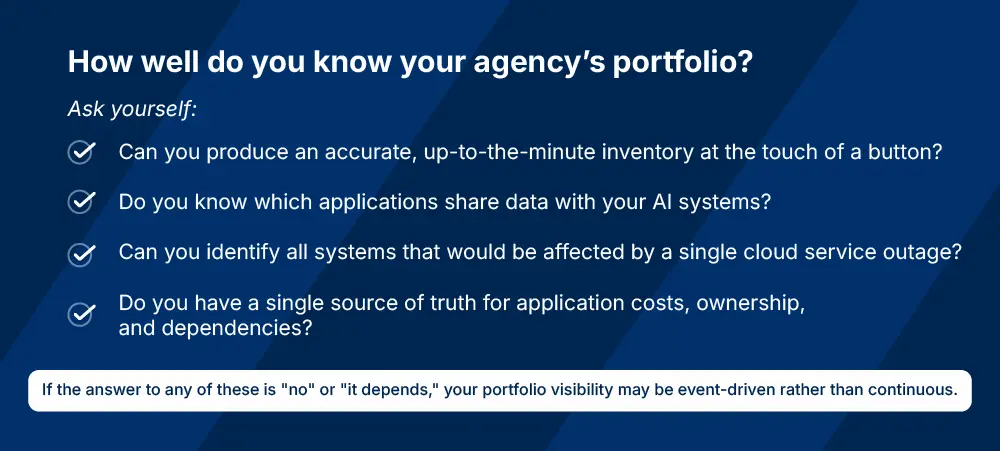
How many systems or applications does your agency operate? How many are redundant? Which ones are unused? Which ones touch Personally Identifiable Information (PII)? If you can't answer those questions in real time, you're not alone; but you're also not prepared for what's coming.
Government departments and agencies are under pressure to modernize faster while controlling costs, strengthening cybersecurity, and governing emerging technologies such as artificial intelligence (AI).
For government IT leaders, these expectations translate into overlapping demands: annual portfolio reviews required under the Federal Information Technology Acquisition Reform Act (FITARA), ongoing modernization and cloud transformation, tightening cybersecurity oversight, and fast-rising expectations for AI governance and transparency.
Translating those mandates into operational outcomes requires a reliable and continuously updated view of the application portfolio so leaders understand which systems exist, what they cost, which mission services they support, and how they interconnect.
In practice, however, that visibility is often assembled piecemeal or in response to an impending event. Application inventories and portfolio information are frequently reconstructed only when oversight cycles require it, for example during audit preparation, budget submissions, or major modernization initiatives. Even the governance processes intended to maintain portfolio visibility can prove difficult to sustain. The Government Accountability Office's November 2024 (GAO) assessment, for example, found that many agencies have not consistently met FITARA's statutory requirement to conduct even annual IT portfolio reviews.
As modernization programs accelerate, cybersecurity obligations tighten, and agencies expand the use of AI systems, these fragmented and episodic portfolio practices create growing operational constraints. Leaders are expected to make modernization, cost, and risk decisions across environments they cannot always see clearly. Without a complete and up-to-date view of the application portfolio, oversight across cost, security, and technology initiatives becomes significantly difficult.
Why Maintaining Application Portfolio Visibility Is Operationally Difficult in Government
Government application portfolios are inherently difficult to map and maintain because they evolve across many systems, programs, and organizational boundaries. These environments rarely exist as neatly maintained inventories. Over time they evolve through successive modernization programs, policy changes, and organizational restructuring, creating technology landscapes that accumulate hidden complexity and technical debt.
FAQs
Application Portfolio Management (APM) is the practice of governing the applications used in an organization. It is an essential strategic planning capability of an IT organization, ensuring that investments in the application landscape are in line with business strategy and that investments are made in a way that minimizes cost and risk, while at the same time delivering the required functionality and flexibility to fulfil business goals.
APM makes visible how applications map to business capabilities, where functional duplication drives unnecessary cost, which technical debt poses the greatest risk, and which dependencies must be managed before change can proceed safely. This visibility allows leaders to prioritize rationalization and modernization based on portfolio-wide impact rather than isolated business cases, helps teams identify consolidation opportunities during mergers or divestitures, and provides the foundation for cloud migration strategies that balance ROI against risk. When application strategy connects to the wider ecosystem of business capabilities, processes, data, and technology, organizations can plan, design, and govern change with confidence.
Application rationalization is the structured, repeatable process of evaluating an application portfolio to determine whether individual applications should be retained, modernized, consolidated, migrated, or retired based on business value, technical health, cost, risk, and dependencies.
Without structured rationalization, agencies often struggle to identify which systems support mission services, where duplicative capabilities exist, how costs are distributed across the portfolio, and where operational or cybersecurity risks accumulate. For public sector agencies, application rationalization provides visibility into mission support, functional duplication, cost distribution, and risk exposure. This visibility enables agencies to control IT operating costs, reduce cybersecurity exposure, eliminate redundant systems, and ensure technology investments remain aligned to mission priorities. When executed as a continuous discipline rather than a periodic cleanup exercise, rationalization becomes a strategic capability that supports faster modernization, stronger governance, and more defensible investment decisions.
Application rationalization is the structured process of evaluating applications to determine whether they should be retained, modernized, consolidated, migrated, or retired. Application Portfolio Management (APM) is the broader discipline of governing applications across their full lifecycle from acquisition through retirement.
Rationalization is a foundational activity within APM, but APM extends beyond periodic assessments to include continuous portfolio visibility, lifecycle governance, investment planning, and alignment with enterprise architecture. When agencies establish authoritative application data and standardized evaluation processes through rationalization, the same foundation supports ongoing APM-adjacent disciplines such as technology portfolio management, strategic portfolio management, and AI governance. Rationalization provides the baseline; APM sustains it as an operational discipline. With purpose-built APM capabilities, Bizzdesign Alfabet enables agencies to initiate rationalization and then extend the same repository and governance workflows into continuous strategic portfolio management.
Federal agencies allocate approximately 80% of their IT budgets to operating and maintaining existing systems, leaving limited funding for modernization. Application Portfolio Management (APM) addresses this constraint by providing the portfolio visibility needed to identify consolidation opportunities, retire redundant systems, and redirect funding toward higher-value initiatives.
When agencies maintain a continuously updated view of their application landscape through APM, they can evaluate modernization opportunities against a complete understanding of dependencies, costs, and mission alignment. This allows leaders to model the financial impact of portfolio decisions before committing budget, assess cloud migration candidates based on technical health and business value, and prioritize modernization investments that deliver measurable mission outcomes. The Federal CIO Council's Application Rationalization Playbook emphasizes repeatable portfolio assessments and governance processes as the foundation for sustained modernization planning. Bizzdesign Alfabet operationalizes this approach by connecting applications to business capabilities, costs, and technical dependencies within a centralized repository, enabling agencies to sustain modernization as a governed discipline rather than an episodic initiative.
Government agencies face converging oversight demands: FITARA portfolio reviews, FISMA cybersecurity compliance, OMB AI governance requirements, and ongoing modernization and cost control expectations. Meeting these mandates requires a reliable, continuously updated view of the application portfolio, not one that's reconstructed for each oversight cycle.
Without continuous visibility, agencies risk falling behind on statutory requirements. The Government Accountability Office's November 2024 assessment found that many agencies have not consistently met FITARA's requirement to conduct annual IT portfolio reviews. When portfolio visibility is ad hoc or event-driven, agencies spend time revalidating inventories and reconciling dependencies before governance decisions can begin. Continuous visibility allows agencies to respond to oversight requirements, assess modernization opportunities, and evaluate emerging risks without rebuilding the baseline each time.
FISMA requires agencies to maintain inventories of information systems and continuously monitor them for security risks. Application Portfolio Management (APM) provides the continuous portfolio visibility needed to meet this requirement by maintaining up-to-date application inventories, ownership information, and dependency maps.
Without continuous visibility, security teams risk operating without awareness of the full system landscape they're responsible for protecting, making it harder to identify unsupported or vulnerable assets and complicating efforts to prioritize remediation activities across the enterprise. Continuous APM visibility allows security teams to identify vulnerable or unsupported systems faster, understand how security risks may propagate across interconnected applications, and prioritize remediation based on a complete view of the enterprise landscape.
AI systems don't operate in isolation. They depend on existing applications for data inputs, integrate with legacy platforms, rely on shared infrastructure, and introduce new dependencies across the enterprise. To govern AI responsibly and meet OMB M-25-21 requirements for AI inventories and ongoing reviews, agencies need to understand how AI systems interact with the broader technology landscape. With approximately 3,000 AI use cases and systems reported across federal agencies as of early 2026, this architectural clarity becomes critical to scaling AI adoption responsibly.
Without continuous portfolio visibility, agencies risk delaying governance decisions and making it materially more difficult to scale AI adoption responsibly. Each time agencies must reconstruct the architectural context needed to evaluate AI systems, enterprise architecture teams spend capacity revalidating inventories and reconciling dependencies, consuming capacity that could otherwise be spent assessing where AI can deliver measurable mission impact. Application Portfolio Management (APM) provides the foundation that makes AI inventorying faster, more accurate, and aligned with enterprise modernization priorities.
As federal AI adoption accelerates, with approximately 3,000 AI use cases reported as of early 2026, agencies face growing pressure to scale AI responsibly while managing operational, financial, and security risks. Generative AI systems introduce unique governance challenges because they depend on underlying application architectures, integrate with legacy platforms, consume data from multiple sources, and often rely on third-party cloud services.
Without continuous portfolio visibility, agencies risk deploying AI systems without fully understanding their dependencies, data lineage, or potential security exposure. Application Portfolio Management (APM) provides the architectural clarity needed to evaluate where generative AI can deliver mission value and where it may introduce unintended risks. By maintaining an authoritative view of AI usage in applications, data flows, and infrastructure dependencies, agencies can assess AI initiatives within the broader enterprise context, identify which existing systems will interact with AI workloads, evaluate whether data quality and governance controls are sufficient to support responsible AI use, and ensure AI investments align with existing modernization priorities rather than creating fragmented technology landscapes. This foundation supports the ongoing AI inventories and risk assessments required under OMB M-25-21 guidance.
Spreadsheet-based approaches typically fail because they cannot maintain continuously updated application inventories, enforce governance workflows, or support repeatable assessment and decision processes at enterprise scale. Spreadsheets may capture a snapshot for a specific oversight cycle, but they cannot maintain real-time dependencies, track changes across organizational boundaries, or connect applications to business capabilities, costs, and risks. As portfolios grow and modernization accelerates, spreadsheet-based rationalization becomes unsustainable.
A purpose-built Application Portfolio Management (APM) platform such as Bizzdesign Alfabet centralizes portfolio data, integrates with existing systems (financial databases, CMDBs, cloud management platforms), automates assessments, enables collaboration across stakeholders, and converts analysis into governed portfolio actions. This allows agencies to sustain portfolio visibility as an operational discipline rather than a periodic reporting exercise.
Agencies evaluating Application Portfolio Management (APM) platforms should prioritize capabilities that support continuous portfolio visibility, repeatable governance processes, and integration with existing enterprise systems. Essential capabilities include:
- A centralized application repository serving as the authoritative source of portfolio information.
- Continuous data synchronization with existing systems (CMDBs, asset inventories, financial systems).
- Workflow-based questionnaires with ownership assignment and validation controls.
- Role-based access ensuring application owners can update systems they manage while maintaining governance.
- Built-in analytics and dependency visualization for multidimensional portfolio analysis.
- Integrated financial views mapping costs to applications, services, and business capabilities.
- Centralized scoring logic ensuring consistent evaluation criteria across departments.
- Portfolio evaluation frameworks (e.g., TIME: Tolerate, Invest, Migrate, Eliminate).
- Program portfolio management linking application portfolio decisions to funded initiatives.
Additionally, FedRAMP authorization is a foundational requirement for US government agencies.
Bizzdesign Alfabet addresses these requirements. It also offers a preconfigured alignment to the CIO Council Application Rationalization Playbook, out-of-the-box integrations with ServiceNow and other enterprise systems, and a centralized repository that connects applications to mission services, costs, risks, and dependencies.
Establishing continuous portfolio visibility requires shifting from episodic inventory exercises to sustained governance practices supported by the right platform, processes, and organizational commitment.
Agencies should begin by designating an authoritative system of record for application portfolio data. This centralized repository becomes the foundation for all portfolio decisions and governance activities. Next, agencies must establish integration pathways that enable continuous data synchronization between the portfolio repository and existing systems such as financial databases, CMDBs, cloud management platforms, and procurement systems. These integrations eliminate the need for manual reconciliation and ensure portfolio data remains current without requiring teams to reconstruct inventories for each oversight cycle.
Governance policies must reinforce the practice operationally. Agencies should align assessment frameworks to recognized methodologies such as the Federal CIO Council Application Rationalization Playbook, which provides standardized evaluation criteria and repeatable processes.
Finally, agencies must build cross-functional participation across business owners, technical teams, security personnel, and financial stakeholders. Purpose-built APM platforms such as Bizzdesign Alfabet enable this collaboration by providing role-based access, standardized workflows, and enterprise-wide dashboards that make portfolio data accessible across organizational boundaries.
FedRAMP (Federal Risk and Authorization Management Program) provides standardized security assessment, authorization, and continuous monitoring for cloud service providers. OMB policy requires federal agencies to use FedRAMP-authorized cloud services when deploying cloud solutions that process federal data.
For agencies adopting cloud-based Application Portfolio Management (APM) platforms, FedRAMP authorization ensures that these platforms meet federal security requirements based on NIST standards and FISMA-aligned controls, supporting the secure handling of sensitive portfolio data (including sensitive information about system architectures, costs, dependencies, and vulnerabilities).It also provides value to agencies in reducing the required workload and shortening the timeline for achieving ATO (Authority to Operate) through inherited security controls.
Bizzdesign Alfabet is an Application Portfolio Management (APM) that operationalizes the CIO Council Playbook through the Application Rationalization Accelerator for U.S. Government, a preconfigured solution aligned to the Playbook's six-step methodology.
The Accelerator enables agencies to initiate structured portfolio analysis shortly after implementation by providing standardized assessment attributes, scoring logic, and reporting structures. Out-of-the-box integrations with ServiceNow (CMDB), Flexera ITpedia (technology catalogue), and enterprise architecture repositories enable continuous data synchronization without custom development.
Unlike spreadsheets or operational tools, Bizzdesign Alfabet connects applications to mission services, costs, risks, and dependencies within a centralized repository. This allows agencies to sustain rationalization as an ongoing discipline, respond to oversight requirements without rebuilding the portfolio baseline, and extend the same foundation into technology portfolio management, strategic portfolio management, and AI governance.



Maintain Visibility. Strengthen Governance. Deliver Mission Value.
Govern your application portfolio to control costs, strengthen cybersecurity, and scale AI adoption responsibly.
Application Rationalization for Government Agencies
Application Rationalization for Government Agencies
How to operationalize the CIO Council’s Application Rationalization Playbook with a purpose-built platform



Ready to Move Beyond Spreadsheet-Based Rationalization?
See how the Bizzdesign Application Rationalization Accelerator delivers measurable cost avoidance, faster modernization, and stronger mission delivery.
The Forrester Wave™: Strategic Portfolio Management Tools, Q2 2026
The Forrester Wave™: Strategic Portfolio Management Tools, Q2 2026
Bizzdesign Is Named a Leader in Strategic Portfolio Management
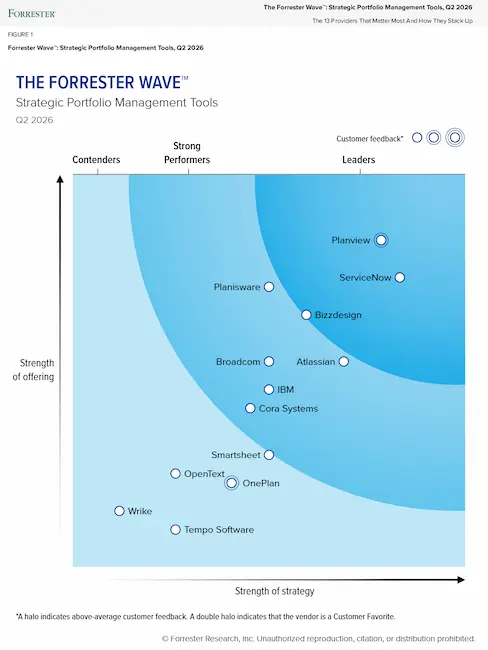
Strategic portfolio management (SPM) is essential as organizations work to balance growth and cost while navigating AI complexity, shifting business priorities, and rising demands for alignment between strategy and execution.
The Forrester Wave™: Strategic Portfolio Management Tools, Q2 2026 evaluates 13 market providers. The report shows how they stack up and helps buyers understand necessary capabilities and market trends shaping the SPM discipline.
Get complimentary access to the report to:
Why Is Bizzdesign Recognized as a Leader?
Bizzdesign was recognized as a Leader, with strategy, modeling, and capability-based planning noted as key differentiators. The report also notes that Bizzdesign best suits enterprises with complex planning needs and an emphasis on enterprise architecture.
The report noted:
- Strategy: "AI investment is a significant part of [Bizzdesign’s] standout innovation."
- Capabilities: "AI capabilities in portfolio management are intuitive and practical."
- Customer feedback: "Customers cite Bizzdesign’s comprehensive planning and modeling capabilities as key standouts."
Why Do Organizations Choose Bizzdesign?
Bizzdesign is uniquely positioned at the intersection of strategic portfolio management (SPM) and enterprise architecture (EA), and is the only vendor recognized as a leader in the SPM Wave to also be named as a leader in The Forrester Wave™: Enterprise Architecture Management Suites, Q4 2024.
That matters because the market is shifting toward a unified transformation control plane. Forrester’s EA research points to a future where strategy, SPM, EA, and IT finance converge to prioritize and govern technology for business value in an AI-driven world.
Bizzdesign is built for that shift, combining EA, SPM, and AI capabilities in one Enterprise Transformation Suite.
Forrester does not endorse any company, product, brand, or service included in its research publications and does not advise any person to select the products or services of any company or brand based on the ratings included in such publications. Information is based on the best available resources. Opinions reflect judgment at the time and are subject to change. This report is part of a broader collection of Forrester resources, including interactive models, frameworks, tools, data, and access to analyst guidance. For more information, read about Forrester’s objectivity here.
Bizzdesign bolts AI and whiteboarding onto enterprise architecture with Unify
Date
Image
Image

Product Categories
Industry Category
Language
Resource Category
Resource URL
https://www.comparethecloud.net/news/bizzdesign-bolts-ai-and-whiteboarding-onto-enterprise-architecture-with-unify
Solution Categories
Adapting enterprise architecture for the AI Act and DORA
Date
Image
Image

Industry Category
Language
Resource Category
Resource URL
https://internationalsecurityjournal.com/adapting-enterprise-ai-act-dora/
Bizzdesign Unify Launches to Bring Enterprise Intelligence to Visual Collaboration
Date
Image
Image

Product Categories
Industry Category
Language
Resource Category
Resource URL
https://enterprisetalk.com/news/bizzdesign-unify-launches-to-bring-enterprise-intelligence-to-visual-collaboration
Solution Categories
Bizzdesign launches Unify to link collaboration & data
Date
Image
Image

Product Categories
Industry Category
Language
Resource Category
Resource URL
https://cmotech.uk/story/bizzdesign-launches-unify-to-link-collaboration-data
Solution Categories
Bizzdesign launches Unify to link collaboration & data
Date
Image
Image

Product Categories
Industry Category
Language
Resource Category
Resource URL
https://itbrief.com.au/story/bizzdesign-launches-unify-to-link-collaboration-data
Solution Categories