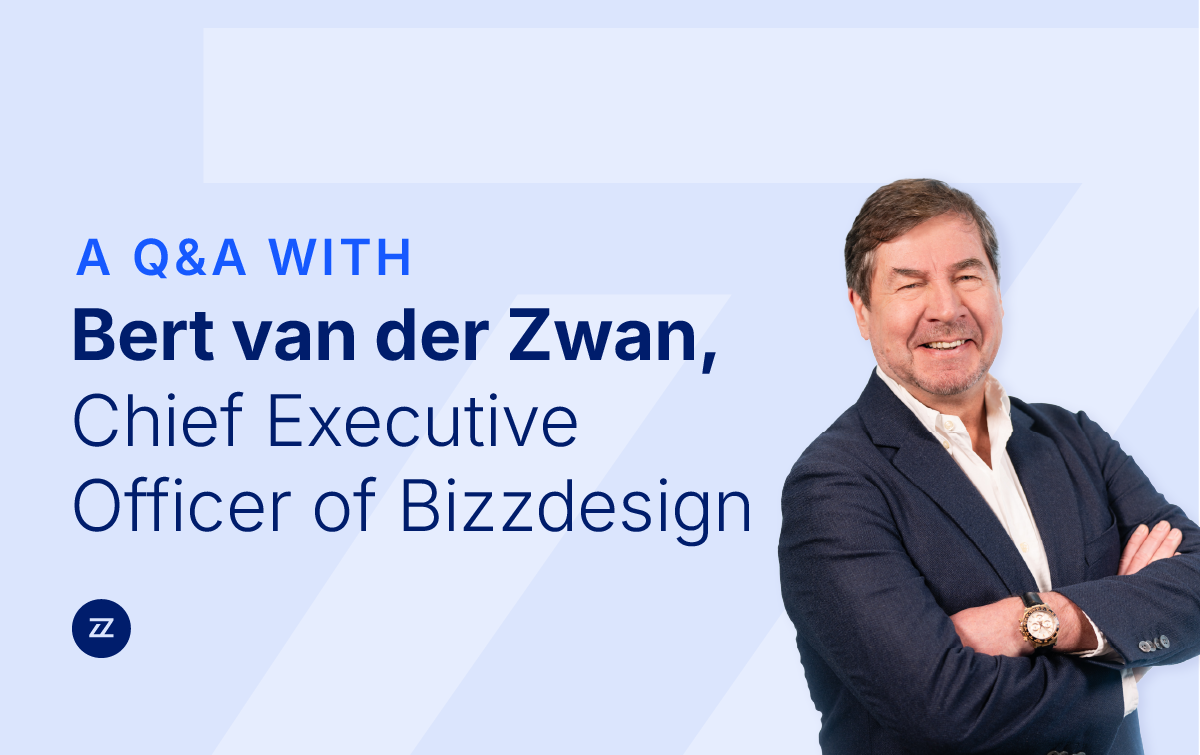
2026 Enterprise Transformation Outlook: A Q&A with Bert van der Zwan

2026 Enterprise Transformation Outlook: A Q&A with Bert van der Zwan

December 17, 2025 - Bert van der Zwan - Leadership

As we prepare for a pivotal 2026, we invited CEO Bert van der Zwan to reflect on the most defining lessons from the past year — and what they signal for transformation leaders navigating AI, modernization, and operating-model change.

This conversation distills the themes shaping boardroom agendas worldwide: the shift from experimentation to execution, the rise of AI-native operating models, and the expanding role of enterprise architecture in connecting strategy to outcomes.

We’re sharing this perspective with the Bizzdesign community to offer perspective on the trends that will define next year’s transformation agenda.

Looking back at 2025, what are the biggest lessons as we walk into 2026?

One of the biggest lessons is that experimentation alone doesn’t guarantee outcomes. The last two years brought a wave of pilot projects — from operating model redesigns to modernization efforts, cloud migrations, and yes, AI initiatives — but most organizations remain pilot-heavy and deployment-light, so the business impact hasn’t materialized. Without foundational readiness, even sizable investments delivered limited returns.


Enterprise Transformation Shifts That Will Define 2026

Enterprise Transformation Shifts That Will Define 2026

December 18, 2025 - Bert van der Zwan - Leadership

What 2025 Taught Us About Enterprise Transformation

Enterprise leaders are entering 2026 with no shortage of ambition, but far less tolerance for drift. After several years of sustained investment in AI, cloud, data, and security, boards and executive teams are no longer debating whether transformation is possible. They are asking a more demanding question: can it deliver consistent, measurable value at scale?

In many organizations, that pressure is most visible in one area: AI. Pilots and proofs of concept are no longer sufficient to demonstrate progress. Leaders now expect evidence that experimentation can translate into scalable operational outcomes, and that the organization itself is designed to absorb innovation at the pace the business requires.

The questions leaders ask are no longer, “Can AI work?” or “Should we modernize?”

It’s now, “How do we make this deliver measurable value, and how do we do it without losing control?”

The shifts shaping 2026 reflect this reality. They mark a new moment for enterprise transformation — one where long-standing architectural, governance, and portfolio disciplines are no longer optional, but central to delivering outcomes at scale.

The Three Shifts Shaping Enterprise Transformation 2026
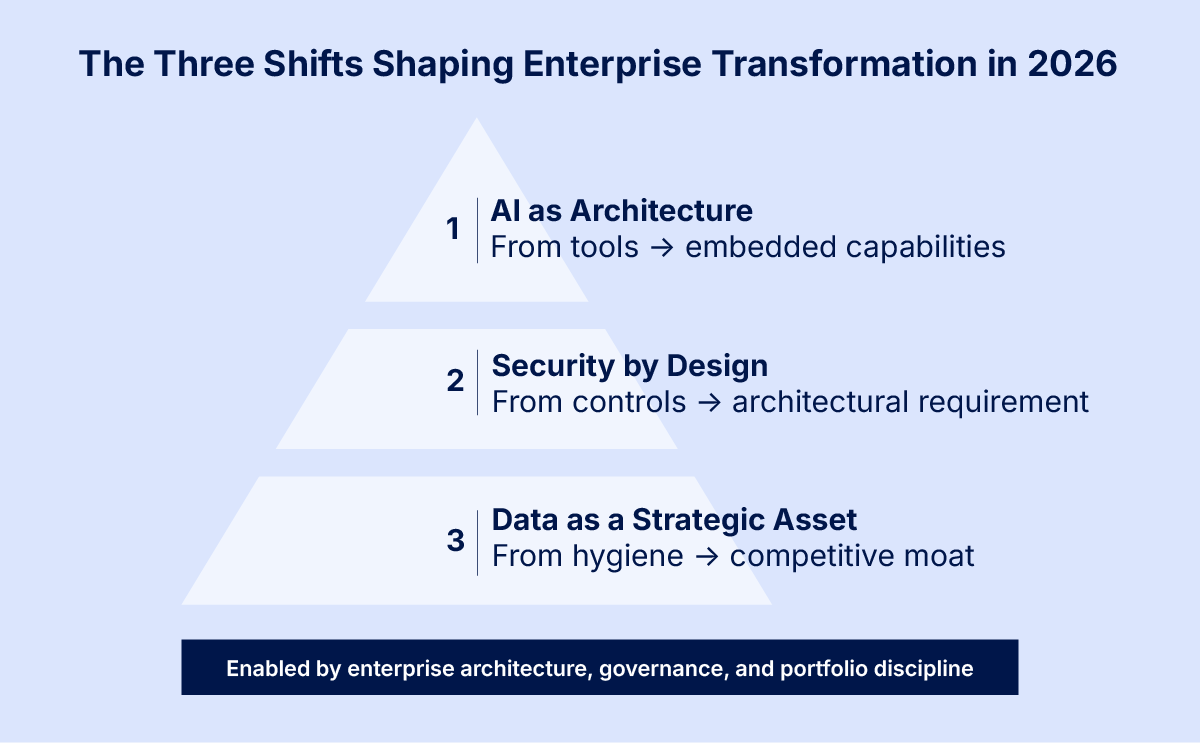
The Three Shifts Shaping Enterprise Transformation in 2026

1. AI Moves to the Core of Enterprise Design

A clear divide is emerging between organizations that add AI onto existing ways of working and those that design AI into how the business actually runs.

FAQs

In 2026, enterprise architecture becomes a central enabler of transformation rather than a supporting function. As AI, distributed systems, and regulatory pressure increase complexity, the challenge for leaders is ensuring the organization can scale change without fragmenting or losing control. Enterprise architecture provides the coherence needed to align strategy, execution, data, and risk across the enterprise, enabling faster decision-making with confidence. Its role shifts from documentation to orchestration, helping organizations turn transformation from a series of initiatives into a repeatable, enterprise-wide capability.

Successful AI adoption depends less on deploying new tools and more on how AI is embedded into the enterprise. Enterprise architecture enables organizations to treat AI as an architectural design choice rather than a standalone solution by providing visibility into where AI creates value, how it interacts with existing systems and processes, and what dependencies or risks must be managed. By modeling AI alongside applications, data flows, and controls, enterprise architecture helps organizations avoid fragmented pilots and scale AI in a way that delivers measurable outcomes while remaining aligned with enterprise priorities.

To deliver consistent business value, AI must be designed into the architecture of the enterprise from the outset, embedded into workflows, systems, and governance structures. This means embedding AI into core workflows, modeling how intelligent agents interact with systems and data, and ensuring governance, security, and accountability are built in from the start. Enterprise architecture plays a critical role in making this possible, providing the visibility and structure needed to scale AI safely across functions and processes. In 2026, the organizations that succeed with AI will be those that architect it with coherence, not just speed.

In 2026, enterprise architecture evolves from a primarily descriptive discipline into an operational one, driven by the demands AI places on the enterprise. As AI introduces greater autonomy, speed, and interdependence across systems, leaders need real-time visibility into how decisions, data, and risks propagate through the organization. Enterprise architecture responds by becoming more dynamic and contextual, modeling AI agents, intelligent workflows, and their dependencies alongside traditional systems and processes. This shift allows organizations to embed governance, security, and accountability into design choices from the outset, enabling AI to scale safely while keeping strategy, execution, and risk aligned.

In 2026, regulations such as the EU AI Act will increasingly shape how AI systems are designed, extending governance into architectural and operational decisions from the start. Requirements around risk classification, transparency, and accountability mean that compliance can no longer be treated as a downstream activity. Organizations will need to embed governance, traceability, and oversight directly into their architectures and operating models. When this is done well, regulation becomes a catalyst for maturity, giving leaders the confidence to scale AI responsibly rather than slowing innovation.

In 2026, executives should prioritize the foundations that make transformation scalable and sustainable, including enterprise-wide design choices that determine how technology delivers value. That means investing in real-time visibility, governed data, embedded security, and a shared understanding of how value flows through the organization. By designing operating models that support autonomy without losing control, embedding AI and security into architectural design choices, and treating data quality as a strategic asset, leaders can ensure that innovation flows through the enterprise in a consistent, governed way. When strategy, execution, and governance are aligned, transformation moves faster — with greater confidence and impact.


 

AI-Driven EA Advantage: Observations of EA Success vs. What’s Coming Next

AI-Driven EA Advantage: Observations of EA Success vs. What’s Coming Next

Watch On-Demand!

AI is rewriting the rules of Enterprise Architecture and the organizations paying attention are already gaining an edge. In this 30-minute session, Dan Hebda exposes the real success patterns shaping EA today and reveals the next wave of AI-powered disruption that EA leaders, architects, CIO advisors, and transformation strategists cannot afford to ignore.


Drive Change. Faster. Smarter.

Want to see how AI will reshape your role, your team, and the future of EA?

EU AI Act Rules Are Rolling Out. The Need for AI Governance Isn't Going Anywhere.

EU AI Act Rules Are Rolling Out. The Need for AI Governance Isn't Going Anywhere.

November 24, 2025 - Tom Jansen - AI in Enterprise Architecture & Transformation

You map your AI landscape, feel confident, and then a key vendor tool is reclassified as “high-risk” under the EU AI Act. Questions immediately follow: Which processes depend on it? What data does it use? Are there alternatives? How quickly can you move?  

From my perspective as Chief Technology Officer, these concerns represent the operational reality many enterprises face as regulations evolve, technology shifts, and transformation continues without a break. The EU AI Act is the latest catalyst. And while the European Commission has extended timelines for high-risk AI obligations to December 2027, the underlying challenge isn't new and it reinforces a simple point: Governance should be part of daily operations. It’s how you manage AI at scale and maintain control as requirements change.

FAQs

Enterprise architecture provides a living inventory of AI systems, mapped to business processes and risk categories. This makes it possible to classify, document, and track high-risk and general-purpose AI while providing traceability and evidence that supports audit readiness.

Application and portfolio management within enterprise architecture tools track which business processes and data depend on third-party AI. If a vendor tool is reclassified as high-risk or prohibited, organizations can instantly see the impact, identify alternatives, and ensure smooth transitions to minimize operational and compliance risk.

With enterprise architecture, organizations can adapt to regulatory changes without starting from scratch — updating inventories, risk classifications, and controls centrally. This means AI transformation strategies stay aligned with both business objectives and the latest compliance requirements.


Bizzdesign Product Roadmap Update

Bizzdesign Product Roadmap Update

June 2026
Get the Latest Updates

All sessions from the latest Bizzdesign Product Roadmap Update webinar are now available on-demand. Watch updates on Bizzdesign Unify, Bizzdesign Alfabet, Bizzdesign Hopex, and Bizzdesign Horizzon at your convenience.

Jump to the recordings


FAQs

These videos will be available until the next product roadmap update.

Yes, you are free to share these resources with your internal colleagues.

Slide decks are available in the Additional Resources section above.

Please reach out to your Customer Success Manager or Account Manager.


Ready for a new way to transform?

Discover Bizzdesign Unify

Survive or Thrive? Why Strategic Planning Defines Success in Business and IT Transformation

Survive or Thrive? Why Strategic Planning Defines Success in Business and IT Transformation

If there’s one thing on the minds of most business leaders today, it’s uncertainty. From the rise of AI to geopolitical instability and shifting trade dynamics, leaders face growing pressure to respond boldly and act with clarity. According to KPMG’s AI Q3 2025 Pulse Survey, 82% of executives expect their industry to undergo significant changes within the next two years.

FAQs

Strategic Portfolio Management (SPM) is the practice of connecting business strategy to the portfolios of work, technology, and investments that deliver it. It helps organizations understand where resources are going, how projects align with strategic goals, and whether change efforts are delivering measurable business outcomes.

Transformation plans typically fail because they’re built on incomplete or disconnected information. Large enterprises have multiple systems, teams, and priorities operating in parallel, resulting in fragmented decision-making and unclear accountability. Without a unified view of dependencies and progress, it’s almost inevitable to lose momentum in execution.

Bizzdesign Alfabet provides a connected view of an organization’s entire IT and business landscape. It helps leaders link strategy to execution by mapping applications, technologies, and investments to business outcomes. With capabilities like AI-supported portfolio analysis, executive-ready reporting, and lean portfolio management, it enables faster, evidence-based decisions and higher return on transformation investments.


When Enterprise Transformation Moves in Flow

When Enterprise Transformation Moves in Flow

November 12, 2025 - Arjan Vork - Leadership

Today’s business landscape is moving faster than ever and in more directions at once. Strategic priorities shift. Market dynamics accelerate. Emerging technologies challenge established norms while exposing new opportunities. Regulatory landscapes are evolving alongside growing economic uncertainty. And yet, the path forward remains more complex than ever.

That’s why leading organizations are building enterprise architecture (EA) and transformation capabilities into the core of how they operate — to anticipate change, align decisions, and move with greater sped and certainty. As Chief Customer Officer at Bizzdesign, I’ve had countless conversations with CIOs, Chief Transformation Officers, and enterprise architects; I hear a constant theme: they don’t need another siloed solution. They need a clearer, more connected way to align strategy and execution. They want transformation that flows.

That’s exactly what the new Bizzdesign is here to enable.

From Three Leaders to One Vision for Enterprise Transformation

This year Bizzdesign, MEGA International, and Alfabet have come together as one company, bringing together decades of leadership across enterprise architecture, strategic portfolio management, and governance, risk and compliance. We now provide a comprehensive foundation for enterprise transformation grounded in decades of leadership, designed to empower organizations to see, shape, and steer change across their entire business.

FAQs

Bizzdesign was named a Leader in the 2025 Gartner® Magic Quadrant™ for Enterprise Architecture Tools, marking its 18th consecutive year in the Leaders quadrant. This recognition reflects nearly two decades of innovation in the enterprise architecture market. Bizzdesign continues to strengthen its offering through increased investment in product development, expanded global reach, and AI-driven innovation, helping organizations bridge the strategy-to-execution gap with greater speed and confidence.

Bizzdesign’s solutions span Enterprise Architecture, Strategic Portfolio Management, Governance, Risk & Compliance, and more. They provide the only true end-to-end enterprise transformation offering, supporting the full journey from strategy to execution. With integrated AI, Bizzdesign helps organizations make smarter investments, strengthen governance, manage risk effectively, and deliver measurable outcomes.

In 2025, MEGA and Alfabet came together with Bizzdesign under one brand. Their products, expertise, and resources are now fully integrated into Bizzdesign. Customers looking for MEGA or Alfabet solutions will find them on bizzdesign.com. To protect customer investments, Bizzdesign will maintain individual product roadmaps for the next five to seven years, while continuing to innovate on new industry-leading products.